Drawing can change the rules of a world
Drawn animation can simplify, exaggerate and transform without maintaining a physically consistent object. A line can become a character, then a landscape, then a typographic gesture. That freedom is valuable when the story relies on association or an expressive point of view. It is not a shortcut around careful design, staging or performance.
Ask how the proposed drawing system behaves in motion. A beautiful still may become unstable when every frame introduces new detail. Conversely, deliberate line variation can provide the life that an overly controlled cleanup pass removes. Review a movement test with representative character scale, texture and background complexity before assuming that a style frame establishes the finished result.
Frame-by-frame drawing and rigged two-dimensional animation have different dependencies, and projects may combine them. Revisions that seem visually small can require extensive redrawing; a rig can make some repeated actions efficient while imposing its own design constraints. Discuss likely shot types and performance needs rather than buying an abstract label such as “handmade.”
CG makes a material system, not just an image
Computer-generated animation is useful when an idea requires controlled geometry, repeatable camera moves, complex transformations or multiple views of the same object. The labour often sits in asset development: modelling, surface work, rigging and look development. A reusable asset can support later outputs, but only if that reuse is anticipated in its design and licensing.
Physical plausibility is a choice, not an obligation. A digitally rendered surface can be photorealistic, graphic or deliberately impossible. The question is whether light, motion and texture express the intended character consistently. Request tests that include difficult reflections, fine details and the intended camera distance rather than judging a material only in a flattering close-up.
ManvsMachine and FutureDeluxe provide public portfolios worth studying for design-led digital imagery. Treat the published films as examples of particular outcomes. They do not establish how much simulation, manual animation or compositing a new commission will need.
Physical animation makes constraint expressive
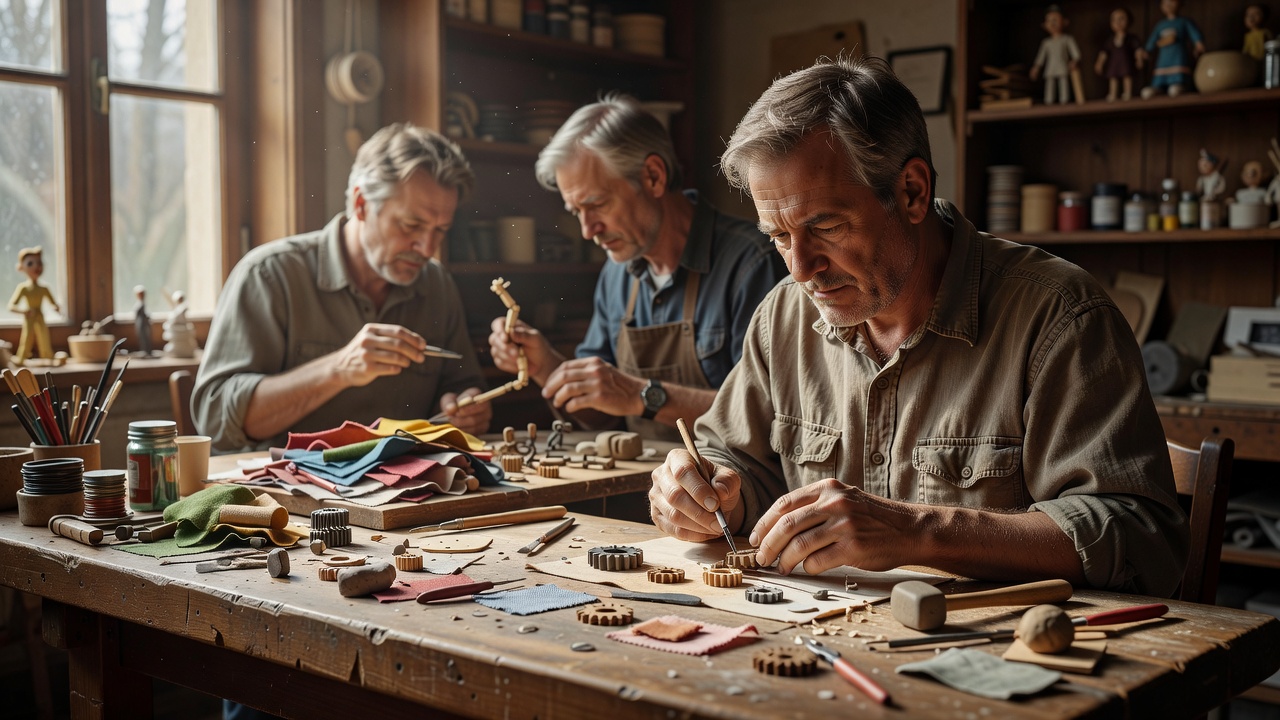
Stop motion gives actual materials a performance over time. Fabric, clay, paper and miniature construction carry qualities that can be difficult to invent from nothing: irregular edges, subtle compression and the particular way a surface catches light. Those qualities become expressive through posing, timing and controlled photography, not merely through the fact that an object exists.
Aardman and LAIKA are established reference points for stop-motion craft. Their public work also makes it unhelpful to treat physical and digital methods as opposites. Fabrication, rig removal, visual effects and compositing can coexist within one production. Ask which visible qualities come from the physical set and which depend on later work.
The practical questions are concrete. Can a puppet achieve the required pose? How many replacement parts are needed? Does a set allow the camera movement? What happens if an approved prop changes after photography? An early physical test can answer questions that a rendered reference image leaves open.
Compare the production consequences
| Method | Useful expressive strength | Dependency to test |
|---|---|---|
| Drawn | Transformation, graphic rhythm and elastic performance | Drawing consistency and revision effort in moving shots |
| CG | Controlled materials, spatial continuity and reusable assets | Asset readiness, render demands and downstream reuse |
| Stop motion | Tactile surfaces and physically performed detail | Fabrication, access, continuity and reshoot feasibility |
| Hybrid | Different methods solving distinct parts of one idea | Integration tests, shared camera data and finishing ownership |
These are planning tendencies, not universal cost or quality rankings. Individual pipelines can differ substantially.
Use hybrid work to solve a specific problem
A hybrid pipeline might place a drawn character inside a photographed miniature or use digital particles around a physical product. The combination is valuable when each method contributes something necessary. It becomes a liability when the treatment adds techniques without accounting for their interfaces. Integration needs shared assumptions about perspective, light, motion blur and grain.
Commission a representative test that crosses the actual boundary between methods. A standalone character test and a separate background test do not prove that the two will sit together. Assign responsibility for the integrated result and confirm who can request changes upstream when finishing reveals a mismatch.
The best choice is the one that supports the intended feeling while remaining explainable in production terms. Keep the unusual material behaviour that gives the film character, but challenge novelty that has no storytelling function. Buyers do not need to become technical directors. They do need enough evidence to understand why a technique is being proposed and what must be protected for it to succeed.